


Te ao Māori is a rich resource for relationship-based practice regardless of the setting, and Māori centred approaches provide frameworks for doing this. Tōu Ake Mana draws from this knowledge system to help us think, in particular, about how kaimahi Māori can build effective relationships with rangatahi Māori that support them to find their own ways to flourish by finding balance.
Te ao Māori is embedded in relational processes. This can be seen in the relationships formed with each other, relationships expressed through whakapapa, relationships with tūpuna, relationships expressed in connection with the spiritual dimensions of life, as well as relationships with te taiao. All of these types of relationships are in play all of the time and tikanga guides their establishment and maintenance. For example, in pōwhiri, tikanga defines how this relational process unfolds, who does what and when. This ensures that roles and relationships are maintained and respected, and spaces are created where human interaction can occur safely.
The te ao Māori view of relationships is wholistic and all encompassing (Eketone, 2019). A high value is placed on establishing and maintaining balance across all of these relationships and careful processes are observed for re-establishing balance when it is disturbed. Flourishing comes from balance achieved through careful attention to relationships.
In Aotearoa, indigenous practice models have always existed. Māori scholars first brought these ideas into the public domain in education (Bishop, 1996; Mead, 1996; Smith, 1997) then in health and mental health (Cunningham, 1998; Durie, 1997) and in social work (Bradley, Bradley & Jacob, 1999; Eketone, 2012; Elkington, 2014; Eruera, 2005, 2012; Hollis, 2006; Hollis-English, 2017; King, 2014; Ruwhiu, 1995; 1999; 2013; Walsh-Tapiata & Webster, 2004; Webber-Dreadon, 2020). These models continue to adapt and evolve (Webber- Dreadon, 2020, 72). Public awareness and use of these models has grown since the 1970s (Hollis, 2006; Oranga Tamariki Evidence Centre, 2021, Walker and Eketone, as cited in Dobbs, 2015).
This document provides some glimpses into te ao Māori ways of seeing relationship-based practice. This is a rich and diverse field of knowledge and the ideas included in this document only skim the surface. It is therefore an invitation to you to continue to explore these ideas and build them into your kete as you grow and develop your practice. Places to start looking for further knowledge are included at the end of this document.
We can think of practice models in Aotearoa as being on a continuum that moves from ways of working informed by Western knowledge only, to Māori centred approaches, and on to kaupapa Maori approaches that draw fully on mātauranga Māori and work with rangatahi Māori and their whānau:

Understanding the value of and difference between knowledge and knowing is important in te ao Māori. Knowledge comes from the head, and knowing from the heart (Coley, Hona, Tutaki & Anderson, 2019). In combination these lead to wisdom. With wisdom, ideas and action enable us to respond to what we know as well as what we value.
 Kaupapa Māori theories increasingly shape the service delivery landscape of Aotearoa. Kerr (2012) notes 5 principles that inform Kaupapa Māori theories (see inset). Initially, kaupapa Māori theory drew parallels with critical theory (see Critical theory) because they both shared a view of the social world as divided into two groups; the powerful and the powerless (Eketone, 2019; Oranga Tamirki Evidence Centre, 2021). At that time, kaupapa Māori scholars saw a common cause with critical theory; equity and social justice could be advanced by social transformation and structural change (Eketone, 2019; Oranga Tamirki Evidence Centre, 2021, 13).
One of the main focii of a kaupapa Māori approach was the operationalisation of self- determination by Māori (Bishop, 1991, 1996; Smith, G., 1990, 1997; Smith, L., 1999). This approach challenges the worldview of power and control vested in Western institutions. In particular, kaupapa Māori challenges the dominance of a Western, individualistic approach to practice. Kaupapa Māori scholars see a strong synergy with indigenous thinkers internationally (Eketone, 2019). This moves kaupapa Māori thinking away from Western ideas, creating space for indigenous knowledge and knowing to expand. As Smith explains:
"...transformative praxis [is created], a Māori form of resistance against all acts, ideologies and forces, which attempt to subordinate Māori knowledge, Māori worldviews". (Smith, 2003, 3)
Māori scholars continue to utilise mātauranga Māori. This knowledge plays important roles in helping to solve the challenges we face in health, education and social areas, as well as to the economy and the environment. Māori centred and kaupapa Māori approaches can now be seen across all fields of human endeavour in Aotearoa. They increasingly influence mahi in non-Māori settings (Munford & Sanders, 2011) as well as practice in iwi and other Māori service delivery contexts. The increasing application of te ao Māori understandings in social services has enriched and advanced our capacity to provide effective support.
Māori centred approaches
The central ideas in relationship based practice fit well with these ways of thinking because of the focus on respectful inter- action and responding to the seen and unseen dimensions of human interaction. Māori continue to pay particular attention to understanding the connection and relationship between all things human and nonhuman, the visible and invisible (Marsden, 1988). These connections and relationships offer insight into how a Māori centred approach can inform kaimahi and services when working with rangatahi Māori.
Māori centred theory first emerged in health research. Cunningham (2000) explained that Māori knowledge was created whenever research involved Māori participants and researchers. The resulting knowledge was, therefore, Māori knowledge and needed to accurately reflect te ao Māori world views. In social work, Māori centred approaches recognise that the foundations of practice are built on knowledge that stretches back across the generations. New Māori social work theories build on this rich knowledge base and reflect the world views and diversity of contemporary Māori society (Hollis-English, 2015, 8).
Tōu Ake Mana demonstrates how Māori centred approaches are grounded in te ao Māori. Relationships are guided by Mana Māori, Mana Atua, ManaTaiao, Mana Tangata and Mana Motuhake. In Māori centred services, Māori are at the core and play significant roles at every stage; in decision making, in design and in delivery. This is important. It ensures Māori have a significant role in determining how delivery occurs and that te ao Māori and mātauranga Māori are at the centre of mahi. In this way, whānau receive quality support in all settings.
Some scholars suggest that Māori centred approaches help us to adopt principled practice (Ruwhiu, 1999; Pohatu, 2008). That is, ways of working that pay careful attention to principles such as respect, integrity and adherence to tikanga. Pohatu (2008) tells us that when we work within a Te Ao Māori framework we can access enduring hoa-haere (travelling companions, mentors) who help guide us.
Key in all of this is the importance of understanding that the ways we practice and the ideas we draw on as we build relationships with rangatahi are shaped by our cultural experiences and our world views (Hollis-English, 2015). To be effective we need to understand our own world views, recognise where our knowledge and knowing comes from, be open to knowledge and knowing created elsewhere, and crucially, also understand the knowledge and knowing of those of the people we support, particularly when it is different to our own.
There are many different ways of thinking about how a Māori centred approach can inform services for rangatahi. Some recent approaches are briefly summarised below:
Te Whare Tapa Whā (Durie, 1984)
Possibly the first and most widely known approach is Te Whare Tapa Whā. It uses the imagery of the four structural pillars or walls of a wharenui to illustrate a Māori way of thinking about health (Durie, 1998a). Each of the four pillars represents a different element, with the building itself standing strongly on the whenua which acts as an anchor. The four Te Whare Tapa Whā pillars are:
Taha tinana - physical health
Taha wairua – spiritual health
Taha whānau – family health
Taha hinengaro – mental health
By paying attention to all four elements and the grounding on the whenua overall wellbeing of Māori is ensured. This framework has been adapted and used in a wide range of practice settings. For example, the mental health foundation. Careers NZ has an adaptation in its careers theories and models toolkit. Healthify He Puna Waiora also has a template.
Tōu Ake Mana
Tōu Ake Mana is a Māori-centred relational framework and can be utilised in any support or intervention to guide interactions with rangatahi Māori on immediate challenges and also with long term goals. It is a set of practice orientations identified in the Pathways to Resilience and Youth Transitions Research (Massey University) that lead to better outcomes when working with rangatahi Māori. It is Māori-centred – rangatahi Māori are at the heart of the kōrero and decision-making. Interventions build on the resources and capacities rangatahi Māori and kaimahi bring to the relationship.Tōu Ake Mana is based on the notion that everyone has mana. It focuses upon ‘how’ kaimahi work with rangatahi Māori in the restoration and maintenance of mana. The practice orientations set out under Mana Māori, Mana Atua, Mana Taiao, Mana Tangata and Mana Motuhake are all interrelated.
Ruwhiu tells us that Mana is: "cultural adhesive that cements together those various dimensions (spiritual, natural, human) of Māori culture and society" (Ruwhiu, 2001, 60).
Indigenous Māori centred models of relational health
Wilson and Moloney (2021) presented a literature review of Māori models of health that highlight the relevance of relational approaches to engaging Māori and their whānau accessing health services. The literature review identified key concepts, principles and values embedded within Māori models of health and wellbeing that can be used to develop a Māori centred relational model of care.The study signalled the essential foundations that kaimahi can use to build trust-based relationships with Māori. Wilson and Moloney (2021) describe three key elements for a Māori centred model of relational care:
- Whakawhanaungatanga – the process of building relationships
- Using tikanga – using cultural protocols and processes
- Being informed by cultural values of aroha, manaakitanga, mauri and wairua.
Mana enhancing approaches
When thinking about the importance of relationships in our mahi with rangatahi, Ruwhiu (2001) reminds us that everyone has mana, that it can be increased, and also reduced or lost depending on how we manage these relationships.
Key in all of this is the importance of understanding that the ways we practice and the ideas we draw on as we build relationships with rangatahi are shaped by our cultural experiences and our world views (Hollis-English, 2015). To be effective we need to understand our own world views, recognise where our knowledge and knowing comes from, be open to knowledge and knowing created elsewhere, and crucially, also understand the knowledge and knowing of those of the people we support, particularly when it is different to our own. By building respectful relationships, kaimahi support growth and development of rangatahi, enhancing their mana. In this process, kaimahi mana also increases.
Māori advancement theory
Māori advancement theory is a way of thinking about the overall development of Māori whānau and communities (Durie,1998a; 1998b). It argues for self-determination (tino rangatiratanga), cultural revitalisation and development that protects te taiao and culture for future generations. Māori advancement theory is a way of thinking about policy and high-level decision making. There are three dimensions to Māori advancement theory (Hollis-English, 2015, 7-8): Improving social, economic, and cultural wellbeing and identity of Māori, individually and collectively. Power and control – Māori control decision making over natural resources, health, education and language so that Māori aspirations and realities are respected. Spirit of development – the capacity to change and respond to today’s realities using tikanga as a guide.
1. Improving social, economic, and cultural wellbeing and identity of Māori, individually and collectively.
2. Power and control - Māori control decision making over natural resources, health, education and language so that Māori aspirations and realities are respected.
3. Spirit of development - the capacity to change and respond to today's realities using tikanga as a guide.
Native theory
Russell (2000) and Eketone (2004) apply this general theory about indigenous peoples’ rights to self-determination in Aotearoa. In native theory, Te Ao Māori knowledge and knowing have the same status as western knowledge and knowing. For relationship-based practice, this means ensuring processes used to engage with rangatahi and their whānau are consistent with tikanga.
Tikanga Māori theory
Many kaimahi Māori draw on tikanga in their mahi even though they may not state this (Hollis-English, 2015). For example, if asked, they will explain that they use “whanaungatanga, whakapapa, te reo Māori and also draw on knowledge of Te Tiriti o Waitangi” (Hollis-English, 2015, 9) in their mahi. These provide foundations for their practice even if they do not specifically identify this. Te Ao Māori values and beliefs such as honesty, integrity and respect for tikanga; using processes such as those based at marae and drawing strength from kaumātua and tohunga knowledge and skills are all part of everyday practice for many kaimahi Māori. Thinking about these as belonging to Tikanga Māori theory can help kaimahi Māori explain their work. Making these links to Tikanga Māori theory is a way kaimahi can signal that their mahi draws on the very large body of Māori knowledge and wisdom.
Takepū
Coley and colleagues developed a set of takepū (principles - see inset) that guided delivery of their social work training programme at Te Wananga o Aotearoa (Coley, Hona, Tutaki & Anderson, 2019). They suggest that these takepū can be used as a framework for reflecting on interactions and obligations in any context, drawing Māori knowledge and wisdom into processes used to support rangatahi to develop and thrive. While developed in an education context, these takepū could also be used to shape practice with rangatahi.
"Tino rangatiratanga: absolute integrity in uniqueness, Whakakoharangatiratanga: respectful relationships, Āhurutanga: a safe space, Kaitiakitanga: responsible stewardship, Taukumekume: the interaction between positive and negative tensions, Mauri ora: well-being" (Pohatu, 2008, p.5).
Māori centred social work practice
There are many different ways of thinking about how a Māori centred approach can inform services for rangatahi. A recent review of Māori centred approaches to social work commissioned by the Evidence Centre at Oranga Tamariki (2021) authored by Amohia Boulton and Lynley Cvitanovich at Whakaue Research for Māori Health and Development, identified key characteristics, principles and aspirations for Māori centred approaches to practice, these are summarised below:


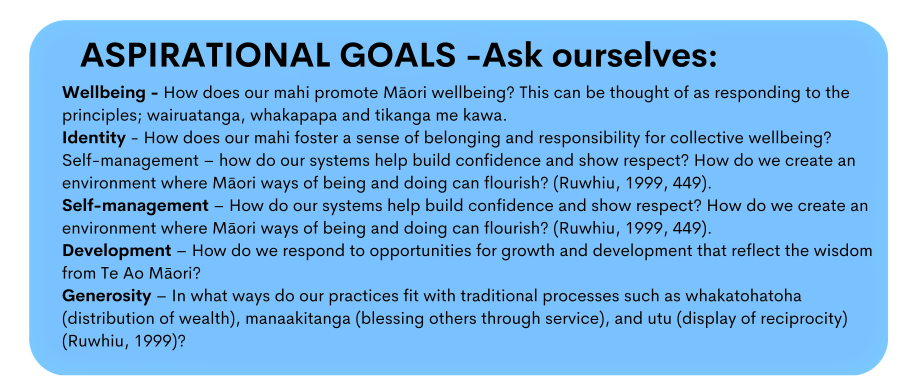
There are a number of ways in which we can develop a Māori centred approach to practice. This includes thinking about the following:

How do I use these ideas in my mahi?
I am a kaimahi Māori supporting rangatahi in a mentoring programme. I was introduced to Tōu Ake Mana last year. It has been an influential part of developing my practice. I was already utilising reflective practice but since the Tōu Ake Mana wānanga I am more intentional about how I do this.
There are so many cultural tools that I can utilise, and I am encouraged to give them a go.
Knowing more about our history in Aotearoa assists me to work alongside rangatahi who have limited knowledge of Te Ao Māori. I have a greater understanding of the barriers and the Tōu Ake Mana Indicators encourages me to use Māori centred resources in my mahi with rangatahi. Each of the indicators have a set of tools that I can draw on.
As confidence in my ability to use the cultural tools grows so too does my ability to use them daily with other kaimahi and rangatahi. I was whakamā to use karakia and te reo Māori at the beginning of our programme, but I have been making opportunities to utilise the resources. I have been practising saying karakia out loud and using more te reo in conversations. I have noticed that my pronunciation has improved, I have a range of options of karakia and words and phrases. I am more confident to participate when others are doing karakia. Reflective practice allows me to consider the needs of rangatahi and how we use cultural tools in our programme. Together we utilise the karakia cards at the beginning and end of our programme. The kīwaha and whakataukī cards are used regularly as reflection cards. Through our programme we are committed to building respectful relationships, providing rangatahi and kaimahi with greater access to te reo Māori and Māori resources.
Here are some places to look for more information
- Bishop, R. (1991a). He whakawhanaungatanga tikanga rua: Establishing links: A bicultural experience. Unpublished masters’ thesis. Department of Education, University of Otago, NZ.
- Bishop, R. (1991b). Te ropu rangahua tikanga rua: The need for emancipatory research under the control of the Maori people for the betterment of Maori people. Paper presented to the 13th New Zealand Association for Research in Education Conference, Knox College, Dunedin, NZ.
- Bishop, R. (1996). Collaborative research stories: Whakawhanaungatanga. Dunmore, Palmerston North, NZ.
- Bradley, J., Jacob, E., & Bradley, R. (1999). Reflections on culturally safe supervision, or why Bill Gates makes more money than we do. Social Work Review, 11, 4, 3-6.
- Coley, L., Hona, D., Tutaki, T., & Anderson, R. (2019). Educational Transformation through Whānau (or marae-a-hapū if you prefer): The centre of our universe. Te Kaharoa, 12.
- Cunningham, C. (1998). A framework for addressing Māori knowledge in research, science and technology. In The Proceedings of Te Oru Rangahau Māori Research and Development Conference, July (pp. 7-9).
- Cunningham, C. (2000). A framework for addressing Māori knowledge in research, science and technology. Pacific Health Dialog, 7, 1, 62-69.
- Dobbs, T. (2015). Te Ao Kohatu: A literature review of Indigenous theoretical and practice frameworks for mokopuna and whānau well-being. Ministry of Social Development. https://practice.orangatamariki.govt.nz/assets/resources/Documents/te-ao-kohatu- literature-review-of-indigenous-theoretical-and-practice-frameworks.pdf
- Durie, M. (1984). Te taha hinengaro: An integrated approach to mental health. Community Mental Health in New Zealand, 1, 1, 4-11.
- Durie, M. (1997). Whānau, whanaungatanga and healthy Māori development. In P. Te Whāiti, M.B. McCarthy & A. Durie (Eds.), Mai i Rangiatea: Māori Wellbeing and Development. Bridget Williams Books, Auckland.
- Durie, M. (1998a). Whaiora Māori health development, (Second Edition). Oxford University Press, Auckland, Durie, M. (1998b). Te mana te kawantanga: The politics of Māori self-determination. Oxford University Press, Auckland.
- Eketone, A. (2004). Tapuwae: Waka as a vehicle for community action. A thesis submitted for the degree of Master of Consumer and Applied Sciences at the University of Otago, Dunedin, New Zealand. Thesis (M CApSc), University of Otago, 2005.
- Eketone, A. (2012). The purposes of cultural supervision. Aotearoa New Zealand Social Work Review, 24 3/4, 20-30. https://doi.org/10.11157/anzswj-vol24iss3-4id104
- Eketone, A. (2019). The principles of Māori directed practice and development. Thesis submitted for the degree of Doctor of Philosophy, University of Otago, Dunedin.
- Elkington, J. (2014). A Kaupapa Māori supervision context - cultural and professional. Aotearoa New Zealand Social Work Review, 26, 1, 65-73. https://doi.org/10.11157/anzswj-vol26iss1id56
- Eruera, M. (2005). He kōrero kōrari – weaving the past into the present for the future (Master’s thesis). Massey University, Palmerston North.
- Eruera, M. (2012). He korari, he kete, he korero. Aotearoa New Zealand Social Work Review, 24(3 & 4) 12–19. https://doi.org/10.11157/anzswj-vol24iss3-4id103
- Hollis, A. (2006). Pūao-te-Ata-tū and Māori Social Work Methods [Unpublished master’s thesis]. University of Otago.
- Hollis-English, A. (2017). Theories in Māori social work: Indigenous approaches to working with and for indigenous people. Aotearoa New Zealand Social Work, 27, 4, 5–15. https://doi.org/10.11157/anzswj-vol27iss4id432
- King, L. (2014). KIAORA - the emerging construction of a bicultural professional supervision model. Aotearoa New Zealand Social Work Review, 26, 1, 20-28. https://doi.org/10.11157/anzswj-vol26iss1id51
- Kerr, S. (2012). Kaupapa Māori theory-based evaluation. Evaluation Journal of Australasia, 12, 1, 6-18. https://doi.org/10.1177/1035719X1201200102
- Marsden, M. (1988). The natural world and natural resources. Māori value systems and perspectives. Resource Management Law Reform Working Paper 29. Part A. Ministry for the Environment, Wellington, New Zealand.
- Mead, L. (1996). Ngā aho o te kakahu matauranga: The multiple layers of struggle by Maori in education (Doctoral dissertation). University of Auckland, Auckland.
- Munford, R., & Sanders, J. (2011). Embracing the diversity of practice: Indigenous knowledge and mainstream social work practice. Journal of Social Work Practice, 25, 1, 63-77. https://doi.org/10.1080/02650533.2010.532867
- Oranga Tamariki Evidence Centre. (2021). Māori centred social work practice: Evidence brief, Wellington, New Zealand: Oranga Tamariki—Ministry for Children. https://www.orangatamariki.govt.nz/about-us/research/our-research/maori-centred-social-work-practice/
- Pohatu, T. (2008). Takepū: Principled Approaches to Healthy Relationships. Proceedings of the Traditional Knowledge Conference Te Tatau Pounamu: The Greenstone Door - Traditional Knowledge and Gateways to Balanced Relationships (pp.241-247). Ngā Pae o te Māramatanga.
- Russell, K. (2000). Landscape: perceptions of Kai Tahu, I mua, āianei, ā muri ake (PhD Thesis). University of Otago, Dunedin, New Zealand.
- Ruwhiu, L. (1995). Home fires burn so brightly with theoretical flames. Social Work Review Te Komako, 7, 1, 21-24.
- Ruwhiu, L. (1999). Te puwaitanga o te ihi me te wehi. The politics of Māori social policy development [Unpublished doctoral dissertation]. Massey University.
- Ruwhiu, L. (2001). Bicultural issues in Aotearoa New Zealand social work. In M. Connolly (Ed.). New Zealand Social Work Contexts and Practices, (pp. 54-71). Oxford University Press, Australia & New Zealand.
- Ruwhiu, L. (2013). Making sense of indigenous issues in Aotearoa New Zealand In M. Connolly & L. Harms (Eds.), Social Work: Contexts and practice (3rd ed., pp. 124-137). Oxford Melbourne.
- Smith, G.H. (1990). Taha maori: Pakeha capture. In: J. Codd, R. Harker and R. Nash (Eds). Political issues in New Zealand Education (pp. 183-197). Dunmore, Palmerston North.
- Smith, G. (1997). The development of kaupapa Māori: Theory and praxis, (IRI PhD Thesis, Series Number 3). University of Auckland, Auckland, New Zealand.
- Smith, G. (2003). Kaupapa Maori Symposium presentation NZARE/AARE Joint Conference Hyatt Hotel, Auckland NZ.
- Smith, L. T. (1999). Decolonizing methodologies: Research and Indigenous peoples. Zed Books, New York.
- Walsh-Tapiata, W., & Webster, J. (2004). Do you have a supervision plan? Social Work Review-Te Komako, 16, 2, 15-19.
- Webber-Dreadon, E. (2020). Kaitiakitanga: A transformation of supervision. Aotearoa New Zealand Social Work, 32, 3, 68-79. https://doi.org/10.11157/anzswj-vol32iss3id770
- Wilson, D., Moloney, E., Parr, J.M., Aspinall, C., & Stark, J. (2021). Creating an Indigenous Māori-centred model of relational health: A literature review of Māori models of health. J Clin Nurs., 1-17. http://doi.org/10.1111/jocn.15859.July 2021
We thank the Ministry of Business, Innovation and Employment for funding the research that created this resource (MAUX2006).
This resource was developed by Justina Webster and Jackie Sanders it was refined by input from Professor Robyn Munford, Dr Jayne Mercier & Dr Linda Liebenberg.
Citation: Webster, J. & Sanders, J. with Munford, R., Mercier, J., & Liebenberg, L. (2023). Māori centred approaches. Relational Resources for Change, https://youthsay.co.nz/rbp-theories/maori-centred-approaches/.
CC BY-NC-ND Licensed using Creative Commons Licensing. Relational Resources for Change Project. You are welcome to use this resource individually, in your teams and in supervision/coaching/critical reflection, you should acknowledge the source using the above citation. You may not change this document, use it to develop your own external training, or for commercial purposes (e.g by charging a fee).


