


Rangatahi told us in the research that they knew they were valued when kaimahi saw beneath all the labels and the chaos to see this valuable, lovable person. They also felt valued when kaimahi saw their coping capacities and strengths. Valuing capacities and abilities is a starting point for participation in social and community life; every rangatahi is valuable and they have things to contribute.
It can be hard to be a ‘good client’; having professionals involved in your life can be challenging and bring up many conflicting emotions. It can remind rangatahi of past experiences of being made to feel powerless and having their experiences discounted or misinterpreted. Rangatahi can be invisible and unwanted in everyday social settings such as shops and businesses. Given these experiences, we can ask ourselves, why should they be ‘good’? (see Working with challenging emotions; Agency and voice; Curiosity and uncertainty).
All of these past experiences come with rangatahi into new support relationships. Sometimes this will be obvious, other times it may be less clear. How they interpret, experience, and then incorporate the experience of this mahi into their own sense of who they are and where they fit, shapes what is possible to achieve through work with them (see Some ideas from psychology that help us understand RBP).
Ideas about shame and recognition (Frost, 2016) help us understand these experiences. These ways of seeing rangatahi experiences are different to the blame and individual responsibility often directed at them (Oliver & Cheff, 2014; Roberts, 2010; ti Riele, 2006). Indeed, in our research, descriptions of shame were the most common theme in rangatahi discussions of their experiences with places like WINZ, such as feeling bad for needing help, or being made to feel inadequate by the way adults treated them (Munford & Sanders, 2019).
Misrecognition is really about adults misunderstanding the causes and meanings of rangatahi behaviour. This was a common feature of the stories rangatahi shared with us about their lives (Munford & Sanders, 2019). Understandably, misrecognition created anger and shame that then distorted their responses to the approaches kaimahi made to them.
When we don’t understand the cause of resistance or understand that challenging rangatahi behaviours come out of their contextual experiences, misrecognition occurs, and our responses are often wrong as a result. In our research, rangatahi talked of misrecognition as lack of acknowledgement of their lived reality (Munford & Sanders, 2019). This undermined any potential value they might get from services. For example, if a kaimahi said rangatahi refusal to participate was non-compliance rather than self-protection, rangatahi were unlikely to be open about their experiences or to participate in the programme or relationship. Rangatahi told us of feeling shame when kaimahi did recognise their challenges. In these cases, they felt that they were the problem and did not deserve the support. They talked of feeling like they were treated with disrespect, were humiliated and excluded, and that their issues and challenges were ignored or dismissed.
When kaimahi recognise rangatahi lives in full and respect their reality, rangatahi will remain with services and gain positive benefits. Here, kaimahi provide care, recognise the reality of the challenges faced and work with rangatahi to identify their own steps on the way to change. Positive recognition is critical.
Honneth's intersubjective theory of recognition
Respect helps with developing a sense of belonging and self-worth. The rangatahi in our research explained that kaimahi showed them respect when they involved rangatahi in decision making and encouraged them to participate in ordinary acts of citizenship and in the life of their communities.
Honneth has developed an ‘intersubjective theory of recognition’ we can use to think about our mahi (Honneth, 1995). There are three dimensions to this: love and care, respect, and being valued. They work together like this:
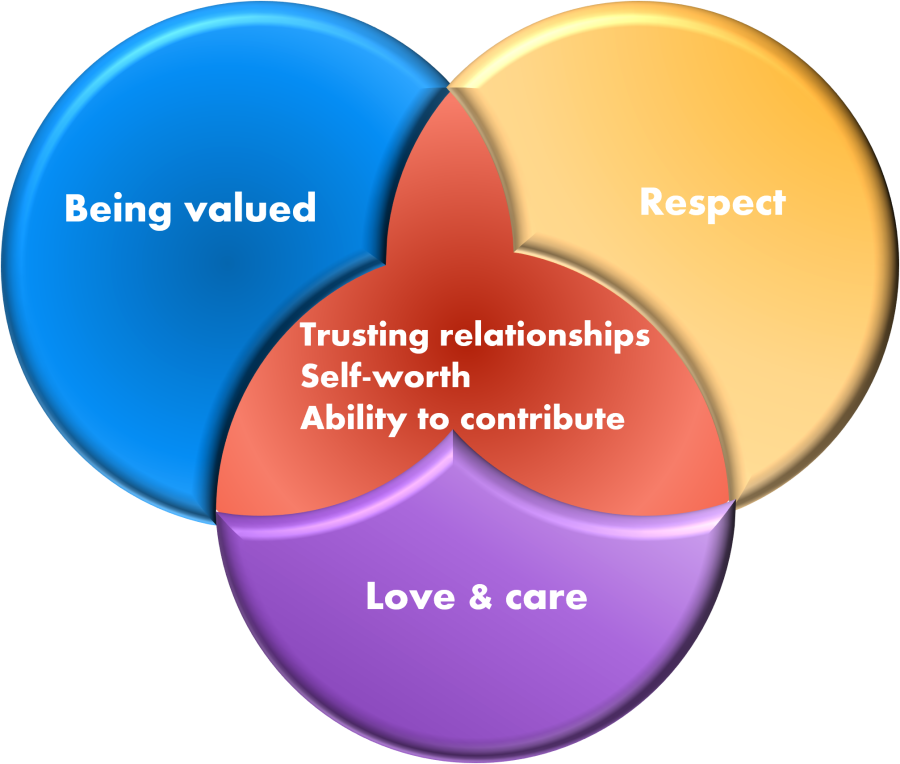
Honneth’s (1995) theory helps us think creatively about the rangatahi we support. It reminds us that the everyday, humble and caring acts we take, show rangatahi how important they are. It fits with the way rangatahi told us about the best experiences they had with services and the experiences that made it easier for them to start working on change.
Honneth’s (1995) three dimensions thread together and when we can demonstrate all of them in practice, rangatahi can build trust-based relationships with us. We can use Honneth’s ideas to increase our compassionate professionalism and humility. We can think that if we were in the rangatahi shoes, we might well make the same choices. Love and care are about helping build emotional wellbeing. Without this, it is difficult to be healthy and have healthy relationships.
Love and care from others is how emotional wellbeing is achieved. It creates a sense of belonging and self-worth. This begins in infancy with strong attachment to key caregiving figures (see Attachment).
Frost (2016) suggests that being loved and cared for is linked to the other forms of recognition; respect, and being valued. The rangatahi in our research often talked of feeling that no-one cared for or about them (Munford & Sanders, 2019). Abandonment was common. There were relatively few stories of caring, or of adults committed to the rangatahi. Where rangatahi told of feeling loved, they spoke of an adult hanging in with them, or they spoke of feeling accepted for who they were and having opportunities to experience every day, ordinary activities as well as cultural and recreational experiences.
As well as showing love and care, these adults also showed respect. Respect helps with developing a sense of belonging and self-worth. The rangatahi in our research explained that kaimahi showed them respect when they involved rangatahi in decision making and encouraged them to participate in ordinary acts of citizenship and in the life of their communities. For example, kaimahi who supported them to be involved in a sporting or cultural activity that others in their community were participating in. Respect helps create a sense of hope about the future. Respect is not complicated; it can be shown in simple acts of human kindness and common decency.
Rangatahi told us in the research that they knew they were valued when kaimahi saw beneath all the labels and the chaos to see this valuable, lovable person. They also felt valued when kaimahi saw their coping capacities and strengths. Valuing capacities and abilities is a starting point for participation in social and community life; every rangatahi is valuable and they have things to contribute. Being valued grows out of trusting partnerships and recognition, without these elements our encounters with rangatahi can appear false and disrespectful (Frost, 2016) (see The helping alliance).
How do I use these ideas in my mahi?
Ginny came to our agency to attend our employment preparation programme. While she loved learning, she did not complete any formal school qualifications as she had been in and out of the care system which had disrupted her education. When she had times of stability, she went back to school, but events would take over and again her learning was disrupted. Both parents had been in prison several times during her childhood and when this happened Ginny went to stay with her grandparents; when they became unwell, she had periods in foster care. She described her life as chaotic; she had difficult relationships with her siblings who had substance abuse issues. Ginny did not want to go down that path and tried hard to resist their pressure to join them in their activities. Her nan was a positive connection (her grandfather had recently died). Her nan encouraged Ginny to follow her dreams.
Ginny wanted to work in the early childhood field and wanted support in finding a way to achieve this. As her youth worker, I supported her alongside as she engaged in the employment preparation programme. We had regular meetings to talk about her feelings and strategies for achieving her goals. She talked a lot about feeling ashamed as her family had such a bad reputation in the town she had lived in. She said she had to work hard to avoid being around them because when she was with them things seemed to go wrong for her. She said at times she felt very angry about her situation and remembered times at school when her teachers talked about her as if she was the same as her siblings. She said if it wasn’t for her nan she most probably would have given up.
Her nan had helped her out when she got really down and supported her to get some mental health support; her nan brought Ginny to our agency. I gave Ginny lots of time to talk about her feelings when she wanted to do that. It was important that she knew that she had a safe space to do this so she could work through these emotions. A recurring theme was Ginny not feeling worthy and deserving of the support people gave her. We worked through this and we talked about how it was important for rangatahi to know that they were respected, loved, and cared about and that it was their right to expect this. We talked about how important it was to feel valued. Given Ginny was interested in working in early childhood, we talked about child development and how important it was for children to be loved and cared for. Ginny responded positively to these discussions which helped her reflect on her situation.
She commented on how the kaimahi at the agency were kind to her and she said this made her feel good. As well as talking about emotions we also worked on practical tasks such as ensuring that Ginny received all her financial entitlements (she was living with her nan) and attended the employment preparation programme which helped her gain confidence and develop important skills that would help her find work. She was excited that she may be able to have some work experience in a childcare centre and to think about what learning she would need to catch up on so she could enrol in an early childhood qualification. As she completed these tasks she started to talk more about her hope for a positive future.
Here are some places to look for more information
- Frost, L. (2016). Exploring the concepts of recognition and shame for social work. Journal of Social Work Practice, 30, 4, 431–446. https://doi.org/10.1080/02650533.2015.1132689
- Frost, L. & Hoggett, P. (2008). Human agency and social suffering. Critical Social Policy, 28, 4:438–460. https://doi.org/10.1177/0261018308095279
- Honneth, A. (1995). The struggle for recognition: The moral grammar of social conflicts. Cambridge University Press, Cambridge, Mass.
- Houston, S. (2016). Empowering the ‘shamed’ self: Recognition and critical social work. Journal of Social Work, 16, 1, 3–21. https://doi.org/10.1177/1468017314566789
- Munford, R. & Sanders, J. (2019). The youth transitions study. Final report. Technical Report 39. Massey University, Palmerston North. https://youthsay.co.nz/wp-content/uploads/Youth-Transitions-Study-Final-Report.pdf
- Munford, R. & Sanders, J. (2020). Shame and recognition: Social work practice with vulnerable young people. Child & Family Social Work, 25, 1, 53-61. https://doi:10.1111/cfs.12652
- Oliver, V. & Cheff, R. (2014). The social network: Homeless young women, social capital, and the health implications of belonging outside the nuclear family. Youth & Society, 4, 5, 642-662. https://doi.org/10.1177/0044118X12448801
- Roberts, S. (2010). Misrepresenting ‘choice biographies’?: A reply to Woodman. Journal of Youth Studies, 13, 1, 137-149. https://doi.org/10.1080/13676260903233720
- ti Riele, K. (2006). Youth ‘at risk’: Further marginalizing the marginalized? Journal of Education Policy, 21, 2, 129- 145. https://doi.org/10.1080/02680930500499968
We thank the Ministry of Business, Innovation and Employment for funding the research that created this resource (MAUX2006).
This resource was developed by Professor Jackie Sanders. It was refined with input from Donna MacNicol, Te Aroha Noa Community Services, Justina Webster, Dr Linda Liebenberg, Professor Robyn Munford, Dr Jayne Mercier, Davinia Abbott and the team at Dingwall Trust Launch Programme
Citation: Sanders, J. with MacNicol, D., Webster, J., Munford, R. Liebenberg, L., Mercier, J., Abbott, D. and the Dingwall Trust Launch Team (2023). Recognition and shame. Relational Resources for Change, https://youthsay.co.nz/rbp-theories/recognition-and-shame/
CC BY-NC-ND Licensed using Creative Commons Licensing. Relational Resources for Change Project. You are welcome to use this resource individually, in your teams and in supervision/coaching/critical reflection, you should acknowledge the source using the above citation. You may not change this document, use it to develop your own external training, or for commercial purposes (e.g by charging a fee).


