


The Pacific is made up of numerous diverse peoples and cultures including, but not limited to Samoa, Tonga, Cook Islands, Niue, Tokelau, and Fiji (Boon Nanai et al., 2022), so there is no singular Pasifika worldview (Anae, 2010). Here, the term Pasifika is used to collectively refer to the many contexts and cultures of Pacific people in Aotearoa (Marsh, cited in Hermes, 2018). This document captures some very broad ideas about some Pacific cultures and values, and ways of supporting Pacific young people focusing on the importance of relationships in this. The document draws mainly on the ideas of Samoan and Tongan scholars. Thus, this summary is a jumping-off point for kaimahi to explore more ideas about Pasifika young people and the reference list at the end offers some places to look for more information.
The importance of relationships
Truth (about self, identity, life) exists and awaits to be discovered through relationships (Toso, 2011 p. 130).
Although Pacific peoples are diverse, the concept of relationships is central to many Pacific peoples (Mafile’o, 2019). It is only through relationships that the individual exists and can develop. These relationships exist beyond people. Connections to land, sea, the spiritual realm, language, and the environment all help to shape individuals, families, communities, and society as a whole (Mila-Schaaf, 2006). Tamasese Ta’isi Efi (2005), from a Samoan perspective describes the importance of connection with the cosmos, the environment, people, and oneself. All of these aspects are equal and familial and exist in both spiritual and ordinary ways. Tiatia-Siau asserts that connections to the cosmos and environment are deeply embedded in all aspects of knowing and being for Pacific peoples (2023). Concepts of connection and harmony provide a backdrop to understanding oneself, one’s relationships, and life’s journey (Toso, 2011).
Historically Pacific peoples were navigators and voyagers and trace their origins to island nations and so connections to sea and land are especially important (Tamasese, 2002). In current times traditional voyaging is being rediscovered and reclaimed. In recognition of these relationships, Brown-Pulu (2002) identifies all peoples of Oceania as tangata/tagata Moana (people of the sea), acknowledging their histories, languages, and cultures and their indigeneity to Pacific islands. The term Oceania recognises connections between different islands, and reciprocal relationships between Pacific peoples in their ancestral lands and abroad, rather than colonial definitions of each Pacific Island as an isolated state (Hau’ofa, 1993). Oceania highlights connection and the wealth of collective knowledge and resources.
Connections between people, place, time and the cosmos guide the interactions, customs, and traditions that maintain individual and collective well-being (Finau, Paea & Reynolds, 2022). The concept of vā, which is common to many Pacific cultures, can help us understand the importance of these relationships. Vā refers to the relational and spiritual spaces between all areas of life and the obligations people have to one another, to the environment, to ancestors and higher powers (Airini et al., 2010; Anae, 2010; Anae et al., 2002; Ioane, 2017; Ledoux-Taua’aletoa, 2019; Matapo & McFall-McCaffery, 2022; Tuagalu, 2008). Because these relationships are central to Pacific worldviews, protection, care, and maintenance of them is important and it forms a central part of all support work. In the Samoan language, protection of the vā is referred to as ‘teu le vā, a process which all people have responsibility for (Airini et al., 2010; Anae, 2010). Its opposite is to trample or desecrate relational spaces, soli le vā in Samoan. Beyond protection, relational spaces also need to be nurtured and developed, in Tongan this is referred to as tauhi vā (Mila-Schaaf, 2006) and tausi le vā in Samoan. Reciprocity is often used in relation to tauhi va.
Tausi le vā /tauhi vā is guided by values. Fa’aaloalo/faka’apa’apa (respect) is a mainstay value for many Pacific peoples. It is central to maintaining relational spaces: respecting others, obligations, relationships, status (Mila-Schaaf, 2006, Ministry for Pacific Peoples, 2022), and for Pasifika young people, respecting authority and elders (Boon-Nanai et al., 2022; Ioane, 2017).
Flowing from these ideas is the importance of family and community, recognising that one is part of a collective that spans time and place. In the context of family and community, all members have duties and responsibilities, so acting on these is how we nurture the vā, nurture the relationship space (tauhi vā). Therefore, working collaboratively and acting for the good of the wider community through service (tautua in Samoan) are important relational principles, as is understanding the impact the past has on the present day (Ministry for Pacific Peoples, 2022). All of these are linked to spirituality, the divine, and the importance of maintaining harmony in all areas.
Mafile’o (2019), suggests that love is a central value, forming the basis of many Pacific greetings. Love relates to showing care through actions in a genuine way and is closely linked to collective views and being of service to others (Mafile’o, 2019). There are many other relational values and ideas that may inform Pacific cultures, communities, families, and individuals. This is by no means an exhaustive list.
"For many Pacific peoples love is inherent in all they do and how theybehave. In the tone of voice, body language, how they greet, apologise, heal, affirm, console, farewell and forgive. It is multi-dimensional, and guides approaches in all relationships with an individual and their family, their genealogies and environment. To love is to be responsible and have a duty of care for self and for all. It is the thread that enables all other values to be sustained and thrive (Ministry for Pacific Peoples, 2022, p. 9).
Navigating multiple worlds
Whilst the ideas above highlight some Pasifika relational views and values, these ideas may or may not be present in the dominant culture of Aotearoa, or in the experiences of Pasifika young people. Pacific individuals are now choosing if, when, in what circumstances and to what extent to identify with the notion of being Pacific, and whether to adopt the aforementioned traditional values. For example, Manuela and Anae (2017) describe how Pacific people born in Aotearoa may identify with the customs and culture of Aotearoa but may not think of themselves as New Zealanders. Equally, those born in Aotearoa and/or of mixed heritage may not fully identify with a Pacific cultural identity and instead develop a hybrid identity that incorporates the complexity of living in and being of different cultures (Hermes, 2019).
Many Pasifika young people in Aotearoa navigate multiple identities in multiple spaces. Tupuola (2004) argues that because of this, Pacific culture and identity cannot be rigidly defined. The many roles of Pasifika young people in school, work, aiga[1], community, church, social, cultural, and political groups, and diverse gender and sexuality spaces exemplify that 20 years on, Tupuola’s assertions are still valid, and the Pacific cultures and identities she refers to are now far more complex.
As one of the authors of this paper further describes:
"There is the Sunday child dressed up for church with the Sunday expectations of behaviour. There is the Saturday child on the rugby field, with quite different expectations of behaviour. There is the school kid with another set of tropes, to study hard and honour the sacrifices others made to provide these opportunities, or not. There is the aiga member at weddings and funerals. There is the ‘plastic[2]’ Islander interacting with his or her cousins from the islands."
As the quote suggests, this navigation can create tension for some between what may be culturally expected and their experiences as Pasifika young people in contemporary Aotearoa. For example, cultural values of respect may suggest obedience to parents, and this may contrast with the freedoms of some peers, and even the views of youth development in Aotearoa which encourage Pasifika young people to speak out (See PYD). They may find ways to meet these different expectations in different places or challenge them. For example, Manuela and Anae (2017), describe how family roles and obligations can get in the way of study for some, whilst for others, these support academic success.
Considering where Pasifika families sit on a continuum of a more traditional family view, towards a more nuclear family view may help to understand where possible tensions could arise for Pasifika young people and the worlds they walk in which will have an impact on how kaimahi support them. The Va’aifetu cultural guidelines from Oranga Tamariki (n.d. p. 9) describe what this continuum may look like. These are broad descriptions and different parts of family life may fall on different parts of the continuum.
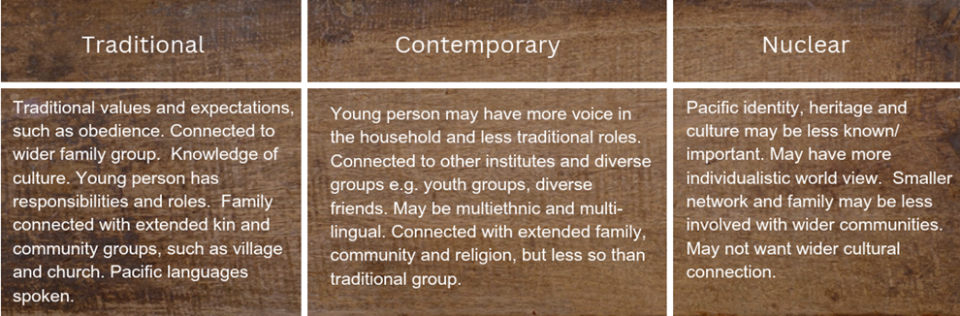
Walking in multiple worlds can be a strength and a challenge. It will be important for kaimahi to recognise how Pasifika young people perceive their different identities and the ways they navigate them so that they can sensitively work with these different selves. Mila-Schaff (2006) suggests that the idea of different identities in different places is linked to vā, and because the individual exists in relationship, identity will naturally be flexible and respond to different environments.
How Pasifika young people navigate different spaces is also influenced by wider factors, such as the role of Te-Tiriti in Aotearoa, experiences of migration, historical factors, such as the dawn raids, climate change, and social and economic influences, like housing supply (see Context). The way these factors impact each Pasifika young person will differ. This means it is important for kaimahi to take time and care in learning about how they combine to influence the challenges each young person faces. In this way, we look at each young person in their context rather than seeing them and their challenges as simply a result of individual factors and choices.
Some theories and frameworks that can help us increase the effectiveness of our support of Pasifika young people
Below are some brief summaries of theories, frameworks and ideas that can help us to understand the worlds of Pasifika young people and how to work effectively with them within these worlds.
Systems theories
Systems theories, such as Bronfenbrenner’s Ecological systems theory (1995) can help us see young people in context (see Systems thinking). Understanding the nested environments that they are part of, from the individual to the familial, community, social systems and historical and political context prompts us to think about the ways they make sense of these spaces and different identities within them. Systems theories can help us to consider all of the different relationships they navigate and maintain.
Understanding these different environments and how they interconnect can also help us to understand their behaviours and the things that can either enable or get in the way of positive change. This knowledge can help us strengthen what is working and identify ways to overcome barriers.

Fonofale
The Fonofale model, developed by Fuimaono Karl Pulotu-Endemann in 1984 is a framework of wellbeing depicting a fale (house). The different parts of the fale and what surrounds it represent the different elements that make up wellbeing.
In Fonofale, family is the foundation, and culture, beliefs and values are the roof, highlighting the importance of both of these elements for safety and wellbeing within Pacific cultures (Manuela & Anae, 2017). The pou represent physical, spiritual, mental, and other aspects of wellbeing.
The fale sits inside a cocoon of time, context, and environment. Sexuality and gender are noted as important identity elements in Fonofale and support of the LGBTQ+ community is included in the model.
Fonofale thinking highlights all of these areas so we can pay attention to them and understand the different ways that these aspects of Pasifika worldviews contribute to well-being. By considering how these elements interact for each Pasifika young person we become aware of those areas where they may be vulnerable and what the right ways of supporting them might be.

Freire’s critical pedagogy (Freire, 1970)
Freire’s critical pedagogy comes from education, but it has been used effectively in many other fields of practice. A key aim of this approach is to support young people to think about their lives and make changes in ways that make sense in relation to their own experiences and environments.
Key for kaimahi when using critical pedagogy is changing the way we see young people; rather than people needing help or needing to know the right ways to do things, we see them as people who bring experience and knowledge that is valuable. Together, kaimahi and young people embark on a journey of discovery, to find their own solutions (see PYD, Agency and voice). A key to doing this well is carefully listening to what they say and being genuinely, and intentionally observant of the things around them that impact on their wellbeing (see Hearing rangatahi).
When we see them bringing valuable ideas and knowledge to helping relationships, a part of our responsibility is to help create spaces for them to start thinking critically about their experiences and the ways they understand the different worlds and contexts they move between. This understanding can help them to find solutions that are meaningful to them. The process of reflection, action, and then reflection is called Praxis (see Critical theory).
The praxis process helps them to question and challenge some of the structural issues that might contribute to their circumstances. By encouraging them to find ways to make sense of their own experiences, critical
pedagogy can help kaimahi to create space for them to explore their own views without assuming that we know their experience, their culture, and what they want and need. This is especially important given the diversity of Pacific cultures.
Turanga Māori
Turanga Māori is a Cook Islands framework of wellbeing (Ministry of Social Development, cited in Mafile’o et al., 2019). It is used in family violence settings and can be applied when supporting Pasifika young people. The framework prioritises the right of individuals and collectives to live a good life, that is in balance. The first part of the framework looks at Akono’anga Māori, which is Cook Islands culture. This includes acknowledgement of papa’anga (genealogy), turanga (position and status), piri’anga (relationships and connections across people, places, time and support networks), and akaua’anga (duties of care within families and communities and between kaimahi and Pasifika young people). Acknowledgement and enhancement of these areas can support ngakau aro’a which is about giving to self and others and seeing oneself as an important part of a whole system.
The second and third parts of the framework relate to time and action. No teia tuatau refers to being of this time, and doing things in ways that are meaningful to Pasifika young people, their families and their context. Tā’anga’anga’ia is about supporting the areas in the first part of the framework in ways that are practical, relevant and effective. This reminds us that supporting Pasifika young people in their cultural identity needs to happen in times and ways that match their own goals and unique situations.
Tango Mou: Pacific cultural humility framework
Tango Mou, tango atui’anga ki te papa tupuna, the Pacific cultural humility framework (Mafile’o et al., n.d.) was developed to build the skills of those working with Pasifika children, young people, and their families. Mafile’o and colleagues explain that cultural humility is about:
- Engaging genuinely with each young person and their family and community,
- Understanding the systemic factors impacting Pacific peoples,
- Reflecting critically on the helping relationship and the power dynamics within it (see Power ),
- Engaging in ongoing learning and prioritising relationships.
Once we have this humble and sensitised understanding, we can then bring in our knowledge and expertise.
The Cultural Humility Framework focuses on both the organisation and the kaimahi. At the organisation level attributes include:
- Celebrating Pacific cultures, communities, faiths, and spirituality,
- Having meaningful connections with Pacific communities,
- Developing the Pacific workforce,
- Having ongoing learning and reflection.
The organisation level is important, because policies, systems and processes can have a big impact on relationship-based practice (see RBP in organisations). The organisation level supports frontline workers to reflect and learn, focus on vā centred relationships, respond to Pacific goals and aspirations, apply Pacific models of practice, and prioritise the language and culture of Pasifika young people and their families.

The Moana framework
The Moana framework was developed by kaimahi at Te Aroha Noa Community Services in Palmerston North as part of the Massey University Youth Transitions Study. It draws on data collected from young people about the ways kaimahi can most effectively engage with them to support positive growth and development. The framework includes qualities of the kaimahi and critical reflective questions that can be used to guide the development of the relationship.
Moana draws on the metaphor of the ocean that links Pacific nations together. It uses familiar imagery linked to the ocean, including waves (young person), shorelines (practice encounters) sand (knowledge and values) and light (reflections) to highlight the qualities kaimahi and their agencies can adopt in their practice. It builds on tā-vā; the understanding that we are all connected to the past and the future, and we are all part of something much larger than any one of us individually.

Translating ideas into practice
"Pacific peoples inhabit multiple social spaces, hold various roles, responsibilities and standing within their families, villages, churches, and communities, occupy a range of experiences, by age, socioeconomic position, gender identity, sexual preference, birthplace, ethnicity, disability, and religious/spiritual affiliation. Genuine Pacific cultural competency embraces and values all diversity" (Tiatia-Siau, 2018, p.8).
A strong and positive ethnic identity is linked to well-being (Manuela & Anae, 2017). Therefore, it is important that we actively engage with Pasifika young people and support their ethnic and cultural identity. However, understanding broad Pasifika concepts, values, and world views does not necessarily translate to good relationship-based practice
with them, because this can lead to stereotypes about who they are, what they need, and what their cultural identity looks like.
Effective support of Pasifika young people will work to understand how all aspects of their life and culture impact upon a particular young person in their particular context. For example, this will involve understanding whether they are second or third generation born in Aotearoa and how this influences their view of themselves. The theories described above help kaimahi to carefully consider the context of each young person, take a humble approach to learn about their experiences and maintain relationships with them and their families and communities.
Using the vā
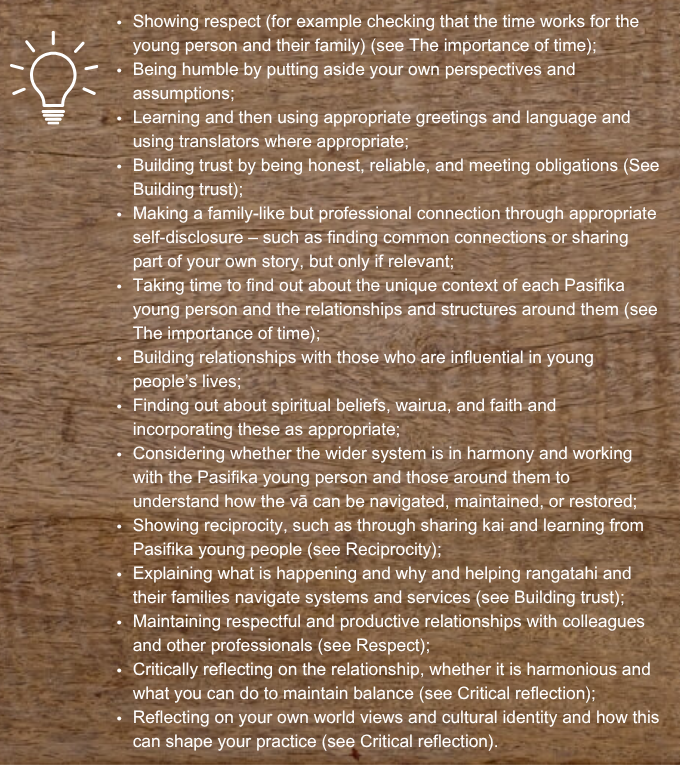
One of the ways kaimahi can be effective is to consider the use of vā in their work. Several authors talk about practical ways to do this (Anae, 2010; Mafile’o, 2019; Mafile’o et al., 2023; Mila-Schaaf, 2006) which can include:
How do I use these ideas in my mahi?
What does a best practice talavou development programme look like in Aotearoa? The issue looksmulti-faceted and complicated. There are four pillars of Pacific life: family, faith, friends, and village.There is an appreciation that Pacific cultural values of service and community are not the driving values of the dominant culture in New Zealand. Talavou have to navigate these different spaces, often weaving between the expectations of traditional values, the expectations of modern Aotearoa, expectations of youth development as providing opportunities for talavou to develop their identity and find their voice, and wider factors impacting their lives.
While these are all important, thinking only in these ways risks taking a top-down approach which sees a forest, and aims to provide each tree with sunlight, water, and deep fertile soil. It does not and has not worked, because each tree is different. An alternative approach is to talk to the trees. What is heard will depend on which trees are talked to in which part of the forest.
Our youth development organisation offers talavou mentoring in sport and support in their academic journeys. In our setting, the trees we work for have a keen interest in sports. Their goals are self-first –they want to be strong, with good looking bodies, and they want to be rich. They want a driver’s licence and a nice car. Then comes family – they want their family to be proud of them and they want to provide for their parents. They are comfortable with honouring and serving the Lord but are unwilling to enrich the church pastor. The village is a place to visit. Little has changed in 50 years. They represent their suburb and their ethnicity with considerable pride. They have friends. They share and are part of a collective. They have different views and values to their parents, but in general they are
quiet about these, partly out of respect, and partly because there is always the prospect of a hiding. They are envious of the freedoms Palagi kids have (Palagi is the Samoan word normally associated with European). They experience racism.
This view from the forest. leads to two quite different strengths-based approaches. The conventional approach is something like, we will build on these strengths to develop good citizens and contributingmembers of society. As adults determine what makes a ‘good citizen’ and ‘contributing member of society’ this approach is paternalistic. The model is a ‘’banking” one where youth are seen as empty accounts to be filled as determined by those in power. Enter Freire.
An alternative approach is to respect the talavou, to help them express their goals, and then toprovide plans and resources that move talavou towards those goals. This is our approach. It is an approach grounded in Bronfenbrenner and Freire together with a huge reliance on co-operative learning and co-requisite remediation.
Bronfenbrenner’s Ecological Systems Theory is a staple in youth development. The central idea is that youth develop as a result of dynamic interactions with their environment. By itself this is not rocket science. However, Bronfenbrenner represented the environment as a set of concentric circles, most of which have no direct interaction with youth, but which affect development. He also introduced the concept of ‘agency’, the ability of youth to affect their own development, in contrast to the determinism of ‘social addresses’ such as gender, ethnicity, and culture.
Freire introduced the concept of critical pedagogy. We regard this as central to our approach. In the context of youth development, we see critical pedagogy as providing youth with the tools, space, and freedom to reflect on social norms and expectations, and then to establish their own value set. This is contrasted to a ‘banking model’ where the role of youth development is seen as filling youth with the ‘right’ attitudes, values, and behaviours.
Cooperative learning in the context of youth development is all about empowering the group to find its own direction in its own way. Within the example of this youth organisation, cooperative learning is derived from peer mentoring relationships. Talavou use their varied strengths to provide learning for other talavou in group settings, who are struggling in certain areas of development. An example of this is where a talavou who is strong in calculus, helps and supports his peer in this subject. The ‘receiving’ talavou who is being supported in this instance, then offers his own support for the ‘giving’ talavou in an area of development for them, such as writing.
Co-requisite remediation in the youth development context is all about having youth lead with their strengths while taking time to fill in deficits or needs along the way. Another classic example in sport is encouraging the hard-running centre to take on the defensive line and attempt to score tries while coaching him that every now and then he could pass to the unmarked winger on his outside. Using this simple analogy illustrates how the advocacy of youth mentoring helps to encourage the talavou to use their talents, and to be bold, and to take a risk at choosing the option they think is the right one. Success or failure is a critical and positive part of their learning and development.
Here are some places to look for more information
Notes:
[1] Aiga is the Samoan word for family.
[2] ‘Plastic’ is a derogatory term adopted to describe a person who cannot speak or understand their native language, or a person who does not understand the nuances and intricacies of their ethnic background. See also Plastic: How This Term Continues to Hurt Our Culture | Measina Treasures of Samoa (measinasamoa.com.au).
Anae, M. (2010). Research for better Pacific schooling in New Zealand: Teu le va-a Samoan perspective. MAI Review, 1-24. https://journal.mai.ac.nz/maireview/article/819
Anae, M., Moewaka Barnes, H., McCreanor, T., & Watson, P. (2002). Towards promoting youth mental health in Aotearoa/New Zealand: Holistic “houses” of health. International Journal of Mental Health Promotion, 4(2), 5-14. https://doi.org/10.1080/14623730.2002.9721855
Airini, Anae, M., Mila-Schaaf, K., Coxon, E., Mara, K., & Sanga, K. (2010). Teu le va—relationships across research and policy in Pasifika education: A collective approachto knowledge generation & policy development for action towards Pasifika education
success: Report to the Ministry of Education. Ministry of Education. https://www.educationcounts.govt.nz/publications/pacific/teu-le-va-relationships-across-research-and-policy-in-pasifika-education
Boon-Nanai, J. M., Manuel, T., Lagolago, W., Lefono, T., Zaveri, V., Seleni, S., & Ponton, V. (2022). Re-examining the ‘culture of silence’ through peer based Pasifika pedagogies in a New Zealand tertiary environment. Journal of Higher Education Policy and Management, 44(2), 185-207. https://doi.org/10.1080/1360080X.2022.2037274
Brown-Pulu, T. J. (2002). Turangawaewae/Tu’ungava’e: Echoes of a place to stand and belong. Journal of Māori and Pacific Development, 3(2), 14-28.
Bronfenbrenner, U. (1995). Developmental ecology through space and time: A futureperspective. In P. Moen, G. H. Elder, Jr., & K. Lüscher (Eds.), Examining lives in context: Perspectives on the ecology of human development (pp. 619–647). American
Psychological Association. https://doi.org/10.1037/10176-018
Freire P. (1972). Pedagogy of the oppressed. Penguin, Harmondsworth.
Finau, S. P., Paea, M. K., & Reynolds, M. (2022). Pacific people navigating the sacred vā to frame relational care: A conversation between friends across space and time. Contemporary Pacific, 34(1), 135-165–165. https://doi.org/10.1353/CP.2022.0006
Friere (2005). Pedagogy of the oppressed. (30th anniversary ed.) Continuum.
Hau’ofa, E. (1994). Our sea of islands. The Contemporary Pacific, 6(1), 147-161.
Hermes, K. L. (2018) The female voice in Pasifika poetry: An exploration of “hybrid” identities in the Pacific diaspora. Journal of Postcolonial Writing, 54:5, 655-669, DOI:10.1080/17449855.2018.1527746
Ioane, J. (2017). Talanoa with Pasifika youth and their families. New Zealand Journal of Psychology, 46(3), 38-45. https://www.psychology.org.nz/journal-archive/Talanoa-with-Pasifika-youth-and-their-families-private.pdf
Ledoux-Taua’aletoa, S. (2019). Understanding the vā for social work engagement with Pacific women and children. In J. Ravulo, T. Mafileó, & D. Yeates, D. (Eds.). Pacific social work: Navigating practice, policy and research. Routledge, Abingdon.
Mafile’o, T. (2019). Social work with Pacific communities. In R. Munford & K. O’Donoghue (Eds.), New theories for social work practice ethical practice for working with individuals, families and communities (pp. 131-142). Jessica Kingsley.
Mafile’o, T., Mitaera, J. Ledoux-Taua’aletoa S. & Temoana, S. (n.d.) Tango moutango atui’anga ki te papa tupuna: Pacific cultural humility framework. Growing the Aotearoa New Zealand children’s workforce capability to work with Pacific families Oranga Tamariki, Massey University.
Mafile’o T., Mitaera, J. & Mila, K. (2019). Pacific-indigenous social work theories and models. In J. Ravulo, T. Mafileó, & D. Yeates, D. (Eds.). Pacific social work: Navigating practice, policy and research. Routledge, Abingdon.
Mafile’o T., Mitaera, J. & Mila, K. (2019). Pacific-indigenous social work theories and models. In J. Ravulo, T. Mafileó, & D. Yeates, D. (Eds.). Pacific social work: Navigating practice, policy and research. Routledge, Abingdon.
Manuela, S., & Anae, M. (2017). Pacific youth, acculturation and identity : the relationship between ethnic identity and well-being : new directions for research. Pacific Dynamics.
Matapo, J., & McFall-McCaffery, J. T. (2022). Towards a va knowledge ecology: Mobilising pacific philosophy to transform higher education for Pasifika in Aotearoa New Zealand. Journal of Higher Education Policy and Management, 44(2), 122-137. https://doi.org/http://www.tandfonline.com/loi/cjhe20
Mila-Schaaf, K. (2006). Vā-centred social work: Possibilities for a Pacific approach to social work practice. Social Work Review, 18(1), 8-13
Ministry for Pacific Peoples (2022). Yavu: Foundations of Pacific Engagement. Ministry for Pacific Peoples. https://www.mpp.govt.nz/assets/Resources/Yavu-Booklet.pdf
Oranga Tamariki (n.d.). Va’aifetu: Guardians and Guardianship of Stars: Principles,Cultural Frameworks, Guidelines. Oranga Tamariki. https://practice.orangatamariki.govt.nz/practice-approach/working-with-pacific-peoples-vaaifetu/
Pulotu-Endemann, K. (2001). Fonofale model of health by Fuimaono Karl Pulou-Endemann: As at September, 2021. https://d3n8a8pro7vhmx.cloudfront.net/actionpoint/pages/437/attachments/original/1534408956/Fonofalemodelexplanation.pdf?1534408956%5C
Tamasese, K. I. (2002). Honouring Samoan ways and understandings: Towards culturally appropriate mental health services. International Journal of Narrative Therapy & Community Work, 2002, 2, 64-71.
Tamasese Ta’isi Efi (2005). In search of harmony: Peace in the Samoan indigenous religion. A Paper for the Colloquium Organised by Pontifical Council for Interreligious Dialogue, Vatican City, Rome, Italy.
Tiatia-Siau, J. (2023, May 23). We're all in this ocean together. Ingenio. www.auckland.ac.nz/ingenio
Tiatia-Siau, J. (2018). The importance of Pacific cultural competency in healthcare. Pacific Health Dialog, 21. 8-9. 10.26635/phd.2018.909.
Toso, V. (2011). Reconceptualising spirituality as philosophy of practice for Pasifika early childhood education in New Zealand: A Samoan perspective. Pacific-Asian Education, 23(2), 129-138.
Tuagalu, I. (2008). Heuristics of the Vā. AlterNative: An International Journal of Indigenous Peoples, 4(1), 107-126. https://doi.org/10.1177/117718010800400110
Tupuola, A. (2004). Pasifika edgewalkers: Complicating the achieved identity status in youth research. Journal of Intercultural Studies, 25(1), 87-100–100. https://doi.org/10.1080/07256860410001687045
We thank the Ministry of Business, Innovation and Employment for funding the research that created this resource (MAUX2006).
Citation: Gavet, S., Mercier, J, Mafile'o, T, & Sanders, J. (2024). Relationship based practice in Pasifika contexts. Relational Resources for Change, https://youthsay.co.nz/rbp-theories/ relationship-based-practice-in-pasifika-contexts/
CC BY-NC-ND Licensed using Creative Commons Licensing. Relational Resources for Change Project. You are welcome to use this resource individually, in your teams and in supervision/coaching/critical reflection, you should acknowledge the source using the above citation. You may not change this document, use it to develop your own external training, or for commercial purposes (e.g by charging a fee).


