


What are care ethics?
Relationships are the centre of all practice. Without a strong, positive relationship, the mahi will not work (Alexander & Grant, 2009; Fewster, 2004; O’Leary et al., 2013; Trevithick, 2003). Care ethics help explain this (Ingram & Smith, 2018). They shift the focus from rules and rights, to caring as a normal part of any relationship. Care ethics can be described in this way:
"Relationships are bi-directional involving an inevitable mutuality – a client’s personality and preferences influence levels and degrees of closeness, entailing that the nature of any personal/professional relationship varies from client to client. There is, therefore, no one way of doing RBP."
Care ethics fit well within te ao Māori and Pasifika understandings (see Māori centred approaches, Relationship-based practice in Pasifika contexts). People are seen as connected, related, and relying on each other for wellbeing. Compassion, nurturing, sensitivity, and care are normal parts of social life. Mahi needs to address both the practical and emotional needs of rangatahi.
This might all seem obvious, who could argue with the idea that kaimahi should care about rangatahi and respond to their needs? But research with rangatahi, tells us that kaimahi do not always do this very well (Duncan, Miller & Sparks, 2007; Garland et al., 2003; Haapasalo, 2000; Heinze, 2013; Sanders & Munford, 2019; Sanders, Munford & Liebenberg, 2017). For instance, often rangatahi report that kaimahi do not take their issues seriously and do not even listen to them. They tell us that kaimahi can be very difficult to contact, that they don’t turn up to appointments, and don’t keep their word. As a result, rangatahi often feel their kaimahi do not care about them and that kaimahi do not see them as capable and able to make and sustain change. This tells us we do not always use care ethics in our practice.
Showing care in professional relationships
Care ethics is about making sure the mahi helps rangatahi to make positive change.
The relationship is not enough on its own though; relationships can be good or bad. In mahi with rangatahi, relationships have a purpose; they are intentional and are focused on positive change. Key words in care ethics are: caring about, taking care of, care giving and care receiving, and reciprocity. Tronto (1993) talked of five steps of care which we can use when thinking about how care ethics might look in our mahi:
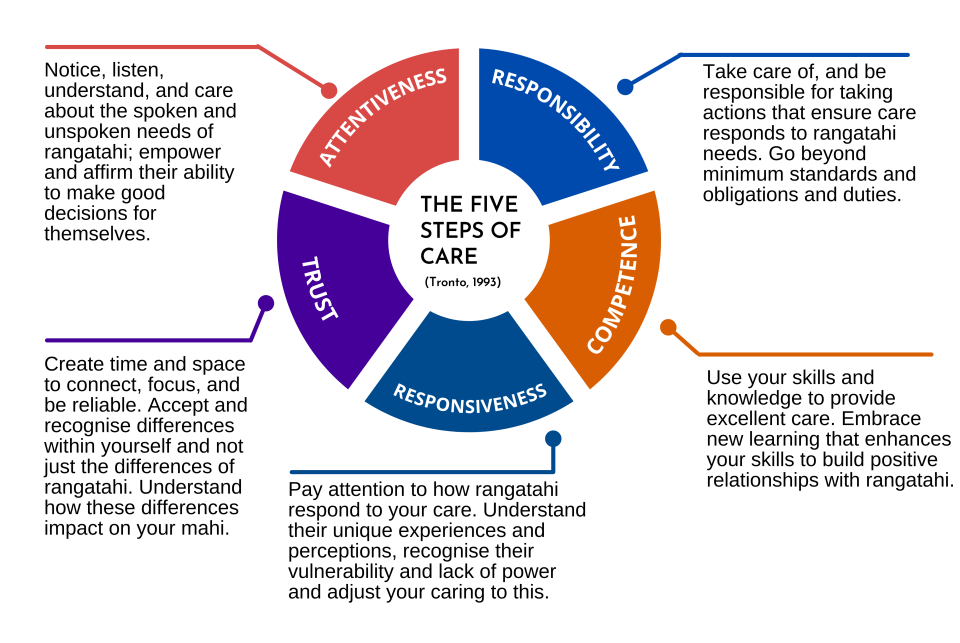
To do this well, kaimahi need to understand themselves and how they can be effective in the relationship. "Beckett and Horner (2006) tell us that change comes about through relationships. Even in situations where programmed interventions are employed, their impact is secondary to the social worker–client relationship (Nicholson & Artze, 2003). Qualities of hope and expectancy that change will occur are also implicated in successful outcomes".
How do I use these ideas in my practice?
At our regular team meetings, we reflect on our mahi with rangatahi; we talk about the support we give to rangatahi through our programmes and we also reflect on the wider practices in our agency, such as how we welcome rangatahi to the agency (show manākitanga) and transition them between programmes and services. We have a diverse group of rangtatahi coming to our youth agency for counselling, an alternative education programme, employment programmes, and parenting programmes. Some of the rangatahi have been coming to the agency for over a year and have been involved in several of our programmes. We always aim to ensure that all the rangatahi that come through our door feel welcomed and are treated respectfully. We want to show them that we care about them and that we value them. We do this by providing a welcoming space that is safe form them to share their experiences with a kaimahi who listens and is non-judgemental. In one of our team meetings the facilitator of our young parents group suggested we could show that we valued rangatahi and their contributions by inviting them to a meeting each month to get their feedback on how we respond to their needs. This would occur outside the usual programmes; kai would be provided. As rangatahi became confident in participating we could ask them to think about running the meeting. We wanted to keep finding ways to show rangatahi that the agency was there for them and was a safe place where they were supported to work on the challenges they faced but was also a place where they could participate in new activities and develop skills that would enable them to achieve their goals. In reflecting on this we saw this activity as a core part of promoting relational practices in our agency and reflecting on how these work in all of the programmes we offer to rangatahi.
I’m a corrections officer who has just received a new file from a retiring colleague. I read in the file of my new parolee Amber. As part of her sentence, she had to write a letter of apology to her victim. Her previous probation officer stated that Amber clearly did not care about her future or her rehabilitation, and as such was not worth concern. As evidence of this, the officer noted that at the end of every session she would ask Amber if she had written the letter yet, to which Amber consistently responded, no. In my first meeting with Amber, I arranged extra time for us to have an opportunity to become more familiar with one another (recognising that relationship building takes time and will continue across our many sessions together). Later in the first session I review the conditions of Amber’s probation with her, and what Amber thinks of these conditions. By doing this I can better understand how Amber makes sense of these conditions and understand their relevance to her life. During this process it seems that she appreciates the need for and purpose of the letter of apology. Rather than focusing in on this, we then review the conditions to see where Amber is at with each of the conditions. Where she is seemingly unengaged, or behind on the conditions, I ask her what would help her to meet these conditions. With some of the conditions she is quick to provide answers. With others, including the letter, she shrugs and says she doesn’t know. Each time we meet after this, we review the list of actions and progress. Where she is struggling, I ask what could help and try to support her with this. After three sessions, Amber starts the session off by saying she has been thinking about the letter and explains that she has never written a letter before and has no idea where to start or what to write. She asks if we can arrange a time for the two of us to work on this.
Here are some places to look for more information
- Alexander, C. & Grant, C. (2009). Caring, mutuality and reciprocity in social worker–client relationships: rethinking principles of practice. Journal of Social Work, 9, 1, 5–22. https://doi.org/10.1177/1468017308098420
- Beckett, C. & Horner, N. (2006) Essential theory for social work practice. Sage, London.
- Collins, S. (2018). Ethics of care and statutory social work in the UK: Critical perspectives and strengths. Practice: Social Work in Action, 30, 1, 3-18. https://doi.org/10.1080/09503153.2017.1339787
- Duncan, B., Miller, S. & Sparks, J. (2007). Common factors and the uncommon heroism of youth. Psychotherapy in Australia, 13, 34-43. https://search.informit.org/doi/10.3316/informit.545300571675378
- Fewster, G. (2004). Making contact: personal boundaries in professional practice. Relational Child and Youth Care Practice, 17, 4, 8-18.
- Garland, A., Aarons, G., Brown, S., Wood, P., & Hough, R. (2003). Diagnostic profiles associated with use of mental health and substance abuse services among high-risk youths. Psychiatric Services, 54, 562–564. https://doi.org/10.1176/appi.ps.54.4.562
- Haapasalo, J. (2000). Young offenders‟ experiences of child protection services. Journal of Youth and Adolescence, 29, 355–371. https://doi.org/10.1023/A:1005151809736
- Heinze, H. (2013). Beyond a bed: Support for positive development for youth residing in emergency shelters. Children and Youth Services Review, 35, 278-286. https://doi.org/10.1016/j.childyouth.2012.10.018
- Ingram, R. & Smith, M. (2018). Relationship-based practice: Emergent themes in social work literature. Insights– A series of evidence summaries. Insight 41. IRISS, Scotland, https://www.iriss.org.uk/sites/default/files/2018-02/insights-41.pdf
- Nicholson, D. & Artz, S. (2003). Preventing youthful offending: where do we go from here? Relational Child and Youth Care Practice, 16, 4, 32-46.
- O’Leary P, Tsui, M. & Ruch, G. (2013). The boundaries of the social work relationship revisited: towards a connected, inclusive and dynamic conceptualisation. British Journal of Social Work, 43, 1, 135–153. https://doi.org/10.1093/bjsw/bcr181
- Sanders, J., & Munford, R. (2019). PARTH practices and better outcomes: Creating 'lucky' encounters between social workers and vulnerable youth. In R. Munford, & K. O'Donoghue (Eds.), New theories for social work practice: Ethical practice for working with individuals, families and communities (pp. 27-43). Jessica Kingsley, London.
- Sanders, J., Munford, R., & Liebenberg, L. (2017). Positive youth development practices and better outcomes for high risk youth. Child Abuse & Neglect, 69,201-212. https://doi.org/10.1016/j.chiabu.2017.04.029
- Steckley, L. & Smith, M. (2011).Care ethics in residential child care: A different voice. Ethics and Social Welfare, 5,2, 181-195. https://doi:10.1080/17496535.2011.571068
- Trevithick, P. (2003). Effective relationship-based practice: A theoretical exploration. Journal of Social Work Practice, 17, 2, 163-176. https://doi:10.1080/026505302000145699
- Tronto, J. (1993). Moral boundaries: A political argument for an ethic of care. Routledge, New York.
We thank the Ministry of Business, Innovation and Employment for funding the research that created this resource (MAUX2006).
This resource was developed by Professor Jackie Sanders. It was refined with input from Donna MacNicol, Te Aroha Noa Community Services, Justina Webster, Dr Linda Liebenberg, Professor Robyn Munford, Dr Jayne Mercier, Davinia Abbott and the team at Dingwall Trust Launch Programme
Citation: Sanders, J. with MacNicol, D., Webster, J., Munford, R. Liebenberg, L., Mercier, J., Abbott, D. and the Dingwall Trust Launch Team (2023). Care ethics. Relational Resources for Change, https://youthsay.co.nz/rbp-theories/care-ethics/
CC BY-NC-ND Licensed using Creative Commons Licensing. Relational Resources for Change Project. You are welcome to use this resource individually, in your teams and in supervision/coaching/critical reflection, you should acknowledge the source using the above citation. You may not change this document, use it to develop your own external training, or for commercial purposes (e.g by charging a fee).


